Veterans Stories - Veteran, Cyborg or both?

March 31, 2023

Veteran, Cyborg or both?

Posted By: Web Admin

SNOWMASS, Colo – John Wade, or Big John, as he is known to the Winter Sports Clinic community, also goes by his own self-proclaimed nickname – John the Cyborg. Wade, an Army Veteran who receives his care at the Cleveland VA Medical Center, served from 1991 to 1998 and again from 2004 – 2012.

John Wade

It was August 2018, in an act of selflessness, that he became an amputee. The brakes failed on a semi he was driving and rather than crushing the cars in his path, he swerved off the road. Seven weeks later, he regained consciousness and discovered he was missing his left leg below the knee. Four suicide attempts later he made a conscious decision to practice self-love and decided he needed to either “be busy dying or be busy living.”

He was at the Cleveland VAMC when he was approached by a researcher who was developing an experimental treatment for amputees. Fast forward to November 2022, and Wade was implanted with 64 electrodes in his left thigh with the hope that it would pick up his brain’s electrical signals for movement. The experimental research is being conducted by researchers from the Massachusetts Institute of Technology (MIT) and Case Western University, in conjunction with the Cleveland VAMC. Eventually, Ward said, he will receive a robotic limb that his brain can control.

Recently, he had the opportunity to test a prototype that plugged into his electrodes, and for the first time in years, he experienced the feeling of his foot hitting the ground.

John Wade

“It brought tears to the eyes of everyone in the room,” he said with a catch in his voice. ”My brain remembered the feeling and I was able to walk normally again.” Ward said another benefit was relief from his phantom limb pain he described as “like sciatic nerve pain.”

And while his robotic leg is still in the development phase, Wade is participating again at the National Disabled Veterans Winter Sports Clinic in Snowmass, Co. This year he had the opportunity to try out another type of prosthetic – a G-3 Infinity Knee that is specifically designed to allow amputees to participate in outdoor activities. The knee features an advanced pneumatic/hydraulic shock that provides an enormous range of options for making micro-adjustments on the fly – extraordinarily useful for sports like downhill skiing. The knee is the brainchild of Brian Bartlett, who created the device after he lost his own leg.

“I’m just so grateful to have these opportunities,” Wade said of the chance to try the G-3 and the ability to participate at this year’s event, adding “Winter Sports Clinic is the Emmy Awards of sports events.”

Veterans Stories - Combat-wounded veteran finds peace in fly-fishing

Combat-wounded veteran finds peace in fly-fishing

Posted By: Web Admin

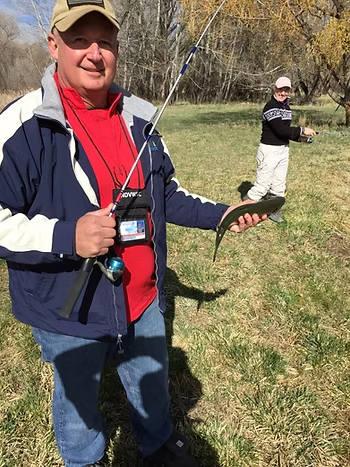
The first time combat-wounded Army veteran John Thomas went fly-fishing, he found peace.

“It was [like] no other feeling,” he said. “I did more looking up and not looking down on the fly and the current water taking it to where I could just see the sceneries around me, and it just took me away.”

John Thomas

It was also therapeutic for his ravaged body. Thomas was in the middle of what he calls “nasty chemotherapy” for non-Hodgkin lymphoma. Standing in the water with waves gently crashing into his back was a relief to his tired joints.

This week, Thomas will enjoy the landscapes and natural remedies of Snowmass, Colorado, as he attends his first National Disabled Veterans Winter Sports Clinic, co-presented by DAV and the Department of Veterans Affairs. While the event is best known for its adaptive skiing, veterans can also participate in sled hockey, curling, snowboarding, snowmobiling and fly-fishing.

“Being outdoors is a mental reset for me,” Thomas said.

His cancer diagnosis in 2015 was one in a series of blows to the double Purple Heart recipient. Thomas was first injured in 2003 when his vehicle was ambushed while guarding traffic control points in Iraq. He sustained shrapnel wounds to his leg but remained in the country and returned to duty soon after.

John Thomas

Then in 2008, he was injured in a suicide bombing while he was on guard in Afghanistan. He sustained traumatic brain and spinal cord injuries, along with more shrapnel across his body. Still, he continued serving. Ultimately, the cancer diagnosis led to his separation from the military in 2016.

“I would still be wearing the uniform to this day [if I could],” Thomas said.

After leaving the Army, Thomas struggled with the effects of his traumatic brain injury and the weight of survivor’s guilt. In turn, he isolated himself.

Until that day on the water. Thomas credits the outdoors and the organization Project Healing Waters Fly Fishing—a previous recipient of a DAV Charitable Service Trust grant—with saving his life.

Now he regularly participates in and guides outdoor excursions with other veterans. He strives to live in honor of his fallen brothers and sisters and help other veterans do the same.

For his sacrifice and selflessness, DAV members in Thomas’ South Carolina hometown collaborated with the TV program “Military Makeover With Montel” to provide Thomas and his family with a more accommodating home. Past Freedom Award recipient and DAV Ambassador CeCe Mazyck made an appearance and invited Thomas to the clinic.

“I’m speechless still, and I’m very grateful to be invited and excited to come join everybody,” Thomas said, adding that he’s most excited about the camaraderie among veterans and building new relationships.

“I just want to share and connect with others to where they can feel comfortable to reach out and I could feel comfortable to reach out, to where we could kick this veteran suicide rate down.”

Veterans Stories - Happy trails

March 30, 2023

Happy trails

Posted By: Web Admin

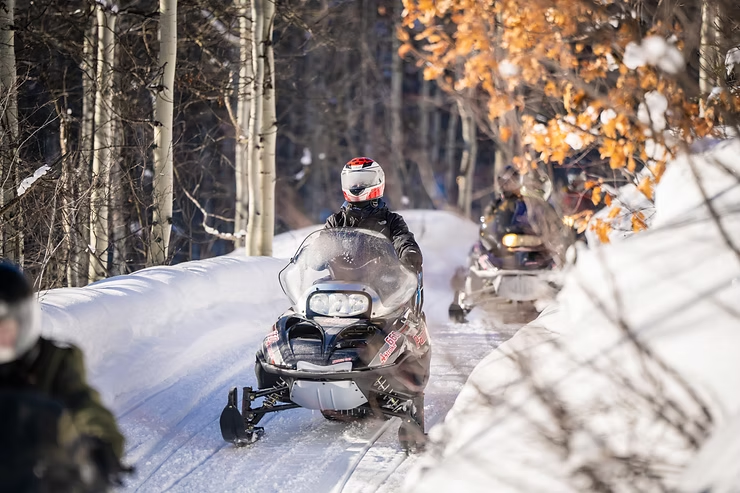
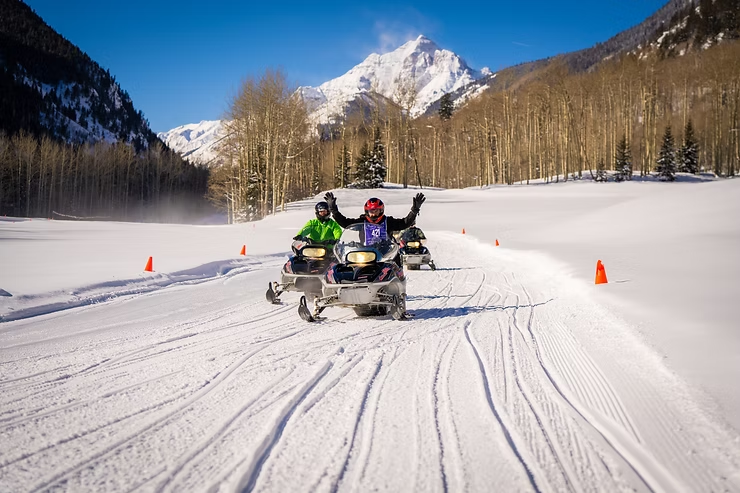
On a cold clear morning, sunlight glints off snowbanks as a line of snowmobiles zip through groves of aspens and towering firs. Pyramid Peak, sister of the famous Maroon Bells, towers ahead and a stunning panoramic view of Aspen lays behind.

Tucked in the scenic Maroon Creek Valley, the T-Lazy-7 Ranch has provided snowmobiling as an alternate activity for the National Disabled Veterans Winter Sports Clinic for more than three decades.

Winter Sports Clinic

“It’s one of our favorite things to do. We love to give back to the Vets and everybody has such a good time,” said owner Rick Deane, “A lot of people come back year after year and you get to know them. Many tell me this is the most fun they have ever had.”

Adapting snowmobiles for disabilities is a constant work in progress for T-Lazy-7. About five years ago, the team developed a seat back that helps paraplegic Veterans ride comfortably. Leg straps assist Veterans with mobility limitations stay safely on the sled, and a buddy will ride with Veterans with spinal cord injuries or limited visibility to help steer.

The crew at the ranch love the Veterans’ sense of humor and laugh about pranks that Veterans have pulled throughout the years. Billy McEnteer has been volunteering to assist Veterans at the WSC event for about 30 years and travels to the T-Lazy-7 every year from Grand Junction, Co. to help during this week. McEnteer recalls riding with a Vietnam Veteran with a spinal cord injury to help him steer. Several minutes into the drive the Veteran shared with McEnteer that he was also blind.

“We had stopped to get resituated, and then I told him to hit the throttle,” said McEnteer. “He said ‘are you sure, you know I’m blind, right?’ He came back for about 10 years after that.”

Deane, and his two children, Jesse Deane and Besha Jervis, run the ranch with the help of 25 seasonal employees. During Winter Sports Clinic, additional volunteers come to the ranch to help serve the Veterans.

Winter Sports Clinic typically falls just a week or two before snowmobiling shuts down for the season. This year, Deane estimates that there is about 5 feet of snow on the ranch, but many years the snow is nearly melted by the end of March.

Winter Sports Clinic

“When there are low snow years, they use the heavy equipment to stockpile snow around the ranch all winter,” said Jervis. “Then they create a ribbon of snow across the meadow. The volunteers and Rick are up all night through the week adding more snow to the trail – they’ll go to amazing lengths to make sure we can serve the Veterans.”

Veterans Stories - Winter Sports Clinic: National Guard Veteran, amputee wants to ‘live not just survive’

Winter Sports Clinic: National Guard Veteran, amputee wants to ‘live not just survive’

Posted By: Web Admin
Sandi Braunstein

For nine years, doctors tried to repair Sandi Braunstein’s leg. She injured it twice in back-to-back incidents in 2007 while she was in the Minnesota National Guard, and it never properly healed.

She pushed through the first injury, which happened on a run during her final exercise at basic training. Another person in the formation fell on her leg as they were going up onto a curb. The second incident came as she was preparing to deploy to Kuwait with her unit.

A fellow soldier was working on their truck when the fuel line broke. Braunstein jumped off the back of the vehicle to help him contain the spill. But she landed on a rock, snapping her leg and three vertebrae in her back.

Surgeries—seven in total over those nine years—were unsuccessful in repairing the damage. In 2019, she elected to have her leg amputated.

This decision didn’t come lightly. Her doctor had spent time with Braunstein and her two daughters to help them understand what amputation meant.

“My youngest is like, ‘I just want my mom to be my soccer coach again and kick a soccer ball with me instead of sitting on the sidelines and falling,’” Braunstein said. “And then my other daughter … was like, ‘I just want my mom to be able to run away.’ That’s heart-stopping for me because having that limb be un-useful just put us in more danger.”

Sandi Braunstein

Her daughter’s comment came because Braunstein is a survivor of domestic violence. Her daughter didn’t want her to ever feel trapped again.

The surgery was successful, but not without its own complications, turning a planned two-week hospital stay into seven months. She didn’t leave the hospital until just a few days before the Covid-19 pandemic effectively shut down the United States. And because her surgery was considered elective, she wasn’t able to start her physical therapy and rehabilitation right away

Braunstein said learning to use a wheelchair and waiting for a prosthetic was hard, and learning how to use a prosthetic once she got one was nearly impossible because gyms and clinics were still mostly shut down at the time.

As an alternative, Kristin Powell, her Department of Veterans Affairs (VA) recreational therapist at the time, recommended trying adaptive sports, including the National Disabled Veterans Winter Sports Clinic co-presented by the VA and DAV.

Braunstein attended the clinic for the first time in 2022, but went in anxious and skeptical about what to expect. Until she experienced it.

“There was a sense of joy and a sense of peace and a sense of camaraderie that’s like when you’re in the military,” she said.

It was a fresh start for her, both to be around and talk with people who had similar experiences as her with losing a limb and to be active again—something she thought she had lost forever along with her leg.

Following her trip to Snowmass, she continued to seek opportunities to be active with adaptive sports by kayaking, fly fishing and participating in a VA summer sports clinic.

She’s also active with DAV, joining Chapter 13 in Grand Rapids, Minnesota, after learning the organization plays such a big role in putting on the clinic.

“I just want to be able to give back and be a part of something that has given me so much hope,” she said.

As a mother of a child with special needs, Braunstein still carries a heavy load and continues to deal with depression. In September, she attempted to end her life after suffering from a residual limb infection.

Yet, she continues to display strength and resilience. The tattoo on her forearm offers a daily reminder of the outlook she tries to maintain—a poppy with the words “I wanna live not just survive.” It’s a phrase her mentor helping her through the amputation process often said.

So, when Braunstein was recently diagnosed with cervical cancer, and her children were worried she would give up, she told them that she doesn’t give up easily and is going to keep pushing through no matter the setbacks.

“My strength comes from my struggles,” she said. “And in those struggles, you find your friends, you find your family, you find that camaraderie. And that’s what DAV has given me back, is I know there’s a lot of times that we probably feel alone, and we’re not.”

She’s looking forward to getting back to the clinic and being around others who have also faced challenges from their illnesses and injuries. She’s bringing with her the message that others can find the peace, joy and camaraderie that she felt the first time she went.

For her family, the National Disabled Veterans Winter Sports Clinic “gave us everything we felt we might’ve lost in our time struggling and really turned what we felt as burdens into something beautiful and lifelong,” she said.

Veterans Stories - Second time’s a charm at Winter Sports Clinic

Second time’s a charm at Winter Sports Clinic

Posted By: Web Admin

Army Veteran David Pettigrew first attended the National Disabled Veterans Winter Sports Clinic in 2003, just six months after he lost his right leg to an IED in Iraq. . He had zero experience with adaptive skiing — and it didn’t go well.

“Six months out from injury I wasn’t even remotely competent to move myself around without skis, and on the skis, I was just turning left and falling over,” said Pettigrew. “I didn’t have enough of a handle on my own mobility yet to learn a new skill.”

Fast forward twenty years and he’s back at the Winter Sports Clinic after whittling more than 100 pounds off his frame. In 2021, Pettigrew made a lifestyle change after witnessing a friend recover from surgery following a back injury. He realized, that at 300 pounds, a similar injury would render him immobile.

“I was basically slowly killing myself with my lifestyle. I spent all of 2021 losing 110 pounds, and then in 2022, the goal was learning how to maintain that. I just started trying anything that recreation therapy has to offer to see what sticks.”

A kayaking skill building program with Adaptive Adventures in Westminster, Colorado, set him on a path that was a pivotal moment in his wellness journey. At the beginning it was a struggle to balance in a kayak in whitewater, but finally, on the last day, he was successful.

“Not one time did anyone say to me ‘you just can’t do it.’ Everybody said, ‘how do we get you to do this.,” Pettigrew said. “That experience was so profound for me in changing my outlook. It’s not that I can’t do this, it’s that I don’t try things. Because if I try things, we can find a way. Adaptive sports are about getting to do the same things as everyone else, even if it’s in a different way.”

The moment sparked a mental and psychological shift that put his wellness journey into overdrive. He learned that while he may not love every sport, the key is just to try. Since then, he has also experienced rock climbing, dragon boating, and now skiing.

In January 2023, he joined the Ignite adaptive skiing program at Eldora Mountain Ski Resort through a partnership with the VA Eastern Colorado Health Care System’s recreational therapy program. The volunteers at Ignite helped him learn to three track and sit-ski, leaving him better prepared and looking forward to his second time at Winter Sports Clinic where, in addition to skiing, he will try sled hockey and SCUBA.

“I didn’t think I’d ever try skiing again, but it’s fun. Once you get comfortable being uncomfortable, you can relax into your body and let your body learn to move.”

Veterans Stories - Retired Air Force pararescue takes to the slopes

March 29, 2023

Retired Air Force pararescue takes to the slopes

Posted By: Web Admin
Winter Sports Clinic

Air Force Veteran Francis “Frankie” Reilly grew up loving sports. Reilly loved to play baseball, football and hockey. He also had a passion for wrestling. Sports allowed him to make friends, taught him teamwork and accountability, and gave him a sense of purpose.

After high school, Reilly wanted to better himself and be a part of a team, which led him to enlist in the Air Force. Always wanting to challenge himself, Reilly volunteered for pararescue (PJ) training after his first deployment to the Persian Gulf.

As a PJ, Reilly deployed multiple times to Afghanistan. In late 2004, Reilly returned from his third deployment after a combat search and rescue mission in which one teammate died and a close friend was seriously injured.

A week after Reilly’s return stateside, his command asked him to perform jumpmaster duties for a dusk static line jump in Arizona. “I just got back from visiting my friend in the hospital and was not mentally and emotionally prepared for this jump,” Reilly said. “But I knew my team needed me and the flight doctor cleared me to go.”

Reilly proceeded with the jump and exited the aircraft in a compromised position. As his parachute deployed, his right leg went through the risers and snapped his leg backward, causing a complete anterior dislocation of the knee. He landed safely but with a severe injury to his leg that required immediate evacuation to a trauma center, where doctors determined that he had torn the artery in his knee and all but one of his ligaments. Additionally, Reilly’s leg was paralyzed from the knee down.

It took over two years, several surgeries and intensive rehabilitation, but Reilly continued his military service as an instructor for pararescue and combat rescue officers. But the damage to his leg was permanent and required constant functional corrective workouts to stay in shape and relieve the associated pain.

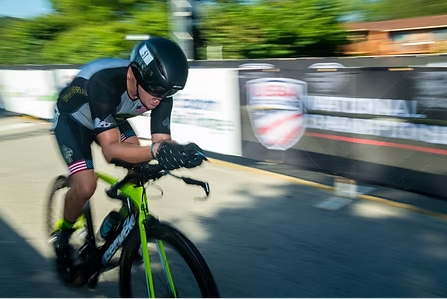
After many years of physical and mental setbacks, Reilly began participating in adaptive sports in events for swimming, cycling and track and is currently training for the paracycling world cup.

“Participating in adaptive sports has been great for my physical and mental health,” Reilly said. “It keeps me active, gets me around great people, helps me avoid isolation and self-medicating.

Winter Sports Clinic

“I look forward to skiing at the winter sports clinic,” he added. “It will be great being around other veterans and training in a new sport. It will give me the confidence to join my family on the slopes. And who knows, maybe I will like it so much that I become a dual sport athlete.”

Veterans Stories - Army Veteran found joy wasn’t just on slopes

March 28, 2023

Army Veteran found joy wasn’t just on slopes

Posted By: Web Admin

Army Veteran Jeff Grieves said he lost something after his 2013 retirement. But he found it again after a friend nudged him to try the National Disabled Veterans Winter Sports Clinic in 2018.

“You’re able to connect with people that you’re on an even keel with,” the Virginia resident said. “They’re banged up, beaten and broken just like you are. You speak the same language. They understand you.”

The experience of his first clinic inspired Grieves to seek out more adaptive sports opportunities with Veterans, including the Department of Defense Warrior Games.

He said there were limited opportunities for him when he first separated from the military.

“I had a miserable experience,” he said. “It took four-and-a-half years for my disability to get finalized.”

During his 22-year career, the combat Veteran of the wars in Iraq and Afghanistan suffered a traumatic brain injury, which has led to constant headaches that he is now able to maintain with alternative treatment. He also has post-traumatic stress disorder, lung damage, back injuries, and a conglomeration of other knee and ankle injuries.

“Twenty-plus years of jumping out of planes just abuses the body,” Grieves said.

This year, he’s back in Snowmass, Colorado, along with his wife to ski and scuba dive. He said he appreciates that the clinic enables her to attend with him as his caregiver.

“That’s always a great advantage,” he said. “We appreciate the VA and DAV.”

Still for Grieves, it’s the bonding with other Veterans that makes each year memorable.

“We just enjoy it so much because we just got to get back in touch with soldiers again, people with like minds and like stories,” Grieves said. “It’s just so enjoyable, and we just looked forward to getting back to it.”

Veterans Stories - Medically retired Navy nurse finds healing on the ski slopes

Medically retired Navy nurse finds healing on the ski slopes

Posted By: Web Admin

When Lisa Veres enlisted in the Navy in 1984, she had planned on making a career out of the military.

“I was on a good path,” she said. “My dad was a Navy pilot and he had a good career, so I was kind of hoping to follow in his footsteps.”

Veres started as a hospital corpsman, and after finishing her nursing degree, received her commission as a Navy Nurse Corps officer.

But when she was deployed during the Persian Gulf War on the hospital ship USNS Comfort, she injured her back. It was severe enough that she was sent to Wilford Hall Medical Center at Lackland Air Force Base, Texas, for care. That’s where doctors discovered and removed a tumor on her spinal cord.

They diagnosed Veres with neurofibromatosis type 1, which can cause tumors to growin the nervous system.

Over the next three decades, she had 15 more surgeries to relieve the pressure on herspine from new tumor growth.

In 1992, the Navy decided to medically retire Veres although she said she could still run and pass a physical readiness test at the time. They felt her condition would become chronic and debilitating. She left service with a 60% service-connected disability rating from the Department of Veterans Affairs and went to work as a civilian operating room nurse.

Around 2008, she started having trouble walking and needed to use canes. She also started having severe back spasms caused by trauma from repeated surgeries.

Her mother suggested looking into a disability rating increase and using the VA for her medical care. Until that point, Veres hadn’t considered either.

The first person she saw at the Raymond G. Murphy VA Medical Center in Albuquerque, New Mexico, was a benefits advocate from DAV.

Veres said he was able to quickly get her a disability rating increase to 100%.

Then while seeking relief for the spasms, Veres was referred to her VA’s spinal cord injury and disorder clinic. Unlike the civilian-sector doctors she’d seen before, the clinic’s doctors were the first to recommend and provide effective treatment that didn’t involveheavy narcotics or surgeries beyond the ones she had already endured.

Winter Sports Clinic

It was also about a decade ago at that spinal cord clinic that a recreational therapistintroduced Veres to adaptive skiing. Skiing had been a big part of her life—she met her husband at a ski club—and she wanted to do it again.

So she signed up for bi-ski lessons in Santa Fe, New Mexico. The training enabled her to go down a mountain with her husband and son for the first time in years.

“It was incredible,” Veres said.

More surgeries prevented her from continuing to ski until this year. She mostly uses a wheelchair now, but she’s happy she’s able to get back onto the slopes. Her recreational therapist signed her up for the National Disabled Veterans Winter Sports Clinic, co-presented by DAV and the VA.

“[I’m looking forward to] showing myself that I’m not relegated to a very small world in my wheelchair,” Veres said. “There’s so much out there.” Veres said she’s looking forward to the challenge of “showing myself that I’m not relegated to a very small world in my wheelchair. There’s so much out there.”

She encourages other veterans with mobility issues to give adaptive sports a try, even if they’re afraid of getting hurt. She praises the instructors and guides and said they make the experience safe and enjoyable.

“The mental healing and well-being that you feel is so much greater than the fear of physical harm,” Veres said.

Veterans Stories - ‘No one ever felt good after giving up’: Airman to compete in sports clinic for disabled vets, troop

‘No one ever felt good after giving up’: Airman to compete in sports clinic for disabled vets, troop

Posted By: Web Admin

https://www.stripes.com/veterans/2023-03-26/disabled-veterans-winter-sports-clinic-9611011.html

Lauren Arduser

WASHINGTON — Airman 1st Class Lauren Arduser said her life changed in one night.

The newly minted Air Force recruit had just arrived in 2022 for training at Goodfellow Air Force Base, Texas. She frequently went out with friends to explore the area and hike in nearby state parks.

One of those trips was halted abruptly when a car that she was riding in unexpectedly flipped several times, crushing her vertebrae, breaking her neck and collapsing her lung.

“I remember feeling really, really tired that day,” said Arduser, 22. “I remember blinking, and on the next blink I woke up 11 days later from a coma.”

She awoke to find she was paralyzed from the neck down. After surgeries and physical therapy, she moved to the St. Louis VA Medical Center — Jefferson Barracks, where she now rehabs three hours a day, five days a week.

Arduser, now a quadriplegic, plans to ski for the first time in her life down the slopes of Snowmass, Colo.

She is one of just two active-duty service members who will participate in the 2023 National Disabled Veterans Winter Sports Clinic.

“Normally the active-duty who participate are in transition out of the service,” said Jason Strickland, the communications director for the clinic.

Arduser and her fellow active-duty service member will join more than 400 veterans with qualifying disabilities at sports clinic out from Saturday through March 31. Hosted by the Department of Veterans Affairs and Disabled American Veterans, the clinic will offer disabled military members opportunities to participate in activities ranging from scuba diving and sled hockey to cross-country skiing and wheelchair self-defense.

Though Arduser has never having skied before, she isn’t nervous.

“I enjoy doing this kind of stuff. I enjoy kayaking, water skiing and other water sports,” she said, noting the chaos of tubing can be a little daunting.

Arduser said she grew up in her family with a sense of duty, with her great aunt and uncle each serving in the military.

“My aunt worked at the Pentagon,” she said. “I kind of looked up to her, and when it was my turn to figure out what I was going to do with my life, it came back to that.”

Arduser would later find out through resurfaced records that her great-grandfather had a military career as well.

Confident she wanted a career in intelligence, Arduser sat down with a recruiter and produced a list of goals that she wanted to accomplish during her military career, including learning to speak Russian.

Though doctors originally thought she might not survive the car crash, Arduser said she was set on proving them wrong.

“I’ve always been one of those people who doesn’t like being told you can’t do something. Maybe it’s stubbornness,” she said.

Arduser said she has always been somewhat of an adrenaline junkie. Her injuries have not changed that.

At the time her recreational therapist recommended the clinic to her, Arduser did not have the level of mobility that she has today.

“My therapist reassured me there’s people participating with all sorts of injuries,” she said.

Arduser said her plan for the week at the sports clinic is to simply go with the flow.

“My recreational therapist is going to advise me what to do,” she said, expecting to go a little outside her comfort zone.

The clinic challenges disabled military members to overcome perceived limitations, allowing them to build upon their experience and continue to lead active, healthy lives, Strickland said.

Arduser said she approaches life now by allowing her emotions to help her, as opposed to bottling up her feelings.

“If I’m struggling to get up off the floor, I’m going to use that anger to push through, power through, because you’re going to get stronger. A lot of it is mental resilience,” she said. “No one ever felt good after giving up.”