Veterans Stories - Triumphant return nearly 20 years in the making
April 16, 2024

Triumphant return nearly 20 years in the making

Posted By: Web Admin
Kevin Blanchard

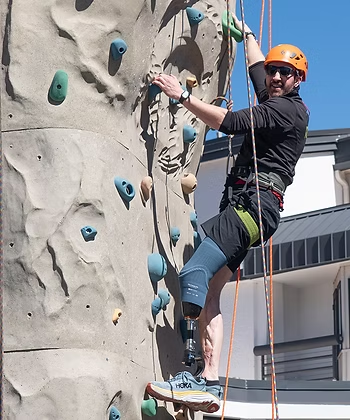
Eighteen years have passed since Kevin Blanchard first stepped foot on the mountain in Snowmass, Colorado. As a first-time National Disabled Veterans Winter Sports Clinic participant in 2006, he was limited in the activities he could take part in because of his fresh wounds.

“I was still in the hospital, I was in a wheelchair, and I had this cage around my leg,” said Blanchard, who was injured in 2005 in Al Anbar, Iraq. “I couldn’t really ski or do much.

“This time will be a lot different.”

On the day he was injured, Blanchard’s convoy was on a patrol when a pressure-plated bomb rigged with two 155 mm artillery rounds exploded beneath his driver’s seat. The blast ripped through the floorboard of the up-armored Humvee, causing Blanchard to lose his left leg below the knee and sustain extensive damage to his right.

He woke up after a 10-day medically induced coma and began his 13-month recovery. Blanchard’s rehabilitation included surgeries every other day for a month, to clean out infections in his wounds, and a bone graft to replace much of his missing tibia.

“It was kind of a blurry time,” he added.

This time around at the Winter Sports Clinic, Blanchard looks forward to getting more confident with snowboarding and skiing. He’s hit the slopes a few times in recent years, as he lives near a ski resort in Virginia. Blanchard hadn’t participated in winter sports before he was injured but is now drawn to adaptive sports.

“I was thinking, what haven’t I done?”  he said. “I was reminded about the Winter Sports Clinic and thought, let’s try it this year.

“I think I can participate a lot more now.”

Besides improving his skills on the slopes and between exertion and relaxation, Blanchard looks forward to the camaraderie with other Veterans the event ensures.

His message to other participants is to always look for ways to improve, no matter where you start.

“Don’t worry about what you can’t do,” he said. “Just get out there and give it a try; it’s courageous and brave to give it a shot.”
Veterans Stories - Collaboration from VA, U.S. Air Force Veteran Advances Adaptive Sports

Collaboration from VA, U.S. Air Force Veteran Advances Adaptive Sports

Posted By: Web Admin
Peter Axelson
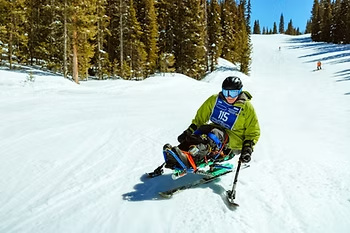
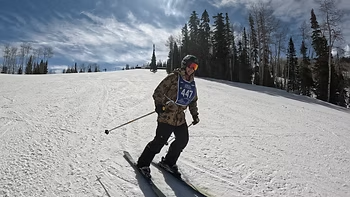
U.S. Air Force Veteran Peter Axelson skis down hill during the 38th annual National Disabled Veterans Winter Sports Clinic. Axelson, who is a five-time world champion, is the inventor of the Arroya, which is the first chairlift-compatible mono-ski with a shock absorber. (Photo by Chris Kelly, VA Media Team)

SNOWMASS, Colo. – Five decades ago, earning the title of “innovator” wasn’t in the cards for U.S. Air Force Veteran Peter Axelson. But after surviving a catastrophic accident at the Air Force Academy in 1975, he pivoted toward the field of engineering. He didn’t realize it at the time, but Axelson’s chosen career would spark an evolution in adaptive sports technology that continues to have far-reaching impacts.

Axelson is the inventor of the Arroya, which is the first chairlift-compatible mono-ski with a shock absorber.

“The addition of the shock absorber made it possible for users of the device to experience improved range of motion on the slopes,” Axelson said. “I’ve been uniquely prepared to do the work that I’ve done, and I can’t imagine any other path that I could have been on. I’m just very thankful for all that I’ve been able to do.”

As a young cadet in the academy, Axelson was on track to become a navigator for the early experimental B-1 bombers. Then one day, while participating in a rock-climbing exercise with an instructor and a fellow cadet, his aspirations were shattered after falling 165 feet to the ground.

“I was very thankful to survive the training accident that I was injured in,” Axelson said. “My classmate and I survived, but our instructor was killed. I had one bone in my vertebrae explode into thousands of pieces – the doctors said there wasn’t a piece bigger than a pea.”

After extensive surgery and months of recovery, Axelson enrolled in Stanford University. While there, he began working on the project that revolutionized the way people in wheelchairs participate in winter sports.

“My version of the sit-ski began as a student project, with some urging from my professor,” Axelson said. “Around the time I was developing the product, the rehab engineering center at the VA in Palo Alto was established and I became one of the first employees there. The VA funded the creation of the first 20 mono-skis.”

After undergoing rigorous testing, Axelson’s mono-ski was officially debuted approximately one year after the initial prototype was designed. In the years that followed, the inventor enjoyed new successes as an athlete, medaling five times in three world championships. Eventually, the self-described “winter sports guy” utilized the technology he created to guide fellow Veterans toward discovering miracles on the mountain during the Winter Sports Clinic.

“I really enjoyed being an instructor, but it wasn’t really possible to teach and participate in the activities,” Axelson stated. “Finally, someone suggested that I come back as a Veteran and I’ve never looked back.”

Axelson continued, “I always try to set new goals for myself to beat during the next year I attend. It’s awesome to see so many Veterans participating in the Winter Sports Clinic, and to know that adaptive technology is such a major component of their lives.”

Veterans Stories - Winter Sports Clinic helps MST survivor heal

Winter Sports Clinic helps MST survivor heal

Posted By: Web Admin
Nikki Wyman
Navy Veteran Nikki Wyman skis during the National Disabled Veterans Winter Sports Clinic in Snowmass Village, Colorado.

SNOWMASS, Colo. – Her eighth trip to the National Disabled Veterans Winter Sports Clinic in 2023 fell while Nicole “Nikki” Wyman was in a dark place. Her mental health was struggling, and she knew she needed help. She found it with a mental health counselor at the clinic, Susan Walker.

Walker is a psychiatric nurse practitioner with the VA Western Colorado Health Care System in Grand Junction, Colorado who provides mental health care through the medical room at the Winter Sports Clinic each year. She is available 24 hours a day throughout the event to ensure that Veterans who need mental health support can receive it.

“I saw Susan every day, I skipped all my alternate activities last year,” recalled Wyman. “I talked about everything and cried, and she told me that I wasn’t the problem, I was the victim.”

Wyman served in the Navy from 1992-1999 as a Religious Program Specialist. Throughout her career she served at Naval Air Facility Adak in Alaska, Marine Corps Air Station Beaufort in South Carolina, Mayport Naval Station in Florida and Parris Island Marine Corps Base in South Carolina.

Her counseling with Susan is just one way that the Winter Sports Clinic has helped Wyman heal from two sexual traumas, PTSD and traumatic brain injuries. She has struggled for years with depression, drug use and suicidal thoughts. She also struggled with dangerous behavior because she didn’t want to live.

“I call it second-hand suicide, where you live so recklessly with drugs, alcohol, wishing you’d have an accident,” said Wyman.

Recreation therapy and the connections she forms at events like Winter Sports Clinic have played a key role in Wyman’s ongoing recovery.

“I love getting out and being active. I need that more,” said Wyman. “I haven’t been living. I cry over that because I haven’t been.”

The 2024 National Disabled Veterans Winter Sports Clinic is Wyman’s ninth trip to Snowmass, and she was in a much better place mentally for this trip. She was happy to see Susan again and reconnect with the many friends she has made over the years.

“I’m just very grateful. I’ve seen so many people I know here, and they say I’m looking better, I’m doing better,” said Wyman. “The Winter Sports Clinic saved my life.”

If you’re having thoughts of suicide, there are resources available and people who want to help you. The caring, qualified responders at the Veterans Crisis Line are ready to listen and help you make a plan to stay safe. Day or night, you can receive crisis support:

If you are experiencing the effects of MST, VA can offer support to suit your schedule and comfort level. To learn more, visit VA’s MST webpage.

Veterans Stories - Ski instructors: “You get more than you give.”

Ski instructors: “You get more than you give.”

Posted By: Web Admin
John Patricio
Photo: Volunteer ski instructors Tom Holmes and Paul Skluzacek take a photo with Marine Veteran John Patricio `before heading out to ski at the National Disabled Veterans Winter Sports Clinic in Snowmass, Colorado.

SNOWMASS, Colo. – At the top of the mountain on day four of the 2024 National Disabled Winter Sports Clinic, three men in their 50s shared a cathartic cry. Marine Veteran John Patricio had just shared his story with his instructors, Tom Holmes and Paul Skluzacek, and the moment brought them to tears.

Holmes, an Air Force Veteran, has been a volunteer instructor with the Winter Sports Clinic for 28 years, and this emotional moment with Patricio is his favorite memory in nearly three decades of incredible memories.

“John is an amazing human, and on the mountain, you can feel vulnerable,” said Holmes. “He told us he used to cry from being in a dark place, but today it was a happy cry.”

Holmes is one about 180 of adaptive ski and snowboard instructors who come to the Winter Sports Clinic from more than 50 adaptive ski programs across North America. The instructors play a crucial role in the clinic, ensuring that Veterans can safely learn how to ski or snowboard with adaptive equipment. Nearly every Veteran at the clinic is accompanied by two instructors on the slopes.

Paul Dowsett, an instructor with the Ontario Track3 Adaptive Sports Association, has been volunteering as an instructor at the Winter Sports Clinic for eight years.

“This event brings together the best adaptive ski and snowboard instructors from Canada and the U.S., so this is the place that we can learn from each other,” said Dowsett. “This is like cramming three or four seasons of learning and innovating at home into one week.”

As volunteers, the ski instructors often take leave from work and travel to Snowmass at their own expense. They network with other adaptive programs and learn about new equipment and techniques — a valuable professional opportunity. But working with Veterans is what keeps them coming back.

“You don’t know how great it is until you’re here,” said Dowsett. “Once I came the first year, I knew that this would be the event that, as long as I’m physically able, I’m coming back.”

For Holmes, getting to share the in the recovery of fellow Veterans is what he treasures about the event.

“For therapy, there’s a difference between checking in at the hospital and checking in on the chairlift. We get to reconnect with nature here, and it’s awesome to get to share that with other Veterans,” said Holmes. “You get so much more than you give here.”

Veterans Stories - Team Miami VA is Ready to Go in Sand, Snow

Team Miami VA is Ready to Go in Sand, Snow

Posted By: Web Admin
Winter Sports Clinic
Veterans and staff from the Miami VA Healthcare System’s adaptive sports team arrived prepared to conquer the mountain during the 38th annual National Disabled Veterans Winter Sports Clinic, in Snowmass, Colo. (Photo by Axel Villacis-Maldonado, VA Media Team)

SNOWMASS, Colo. – Draped in neon orange fleece, the assembly of Veterans and coaches who comprise the Miami VA Healthcare System’s adaptive sports team is hard to miss, but it’s not just their clothing that unites them. These vibrant individuals also share a passion for laughing in the face of adversity and during the 38th annual National Disabled Veterans Winter Sports Clinic, they’re doing just that.

“Veterans are the only population who have given so much, and are still willing to give more,” said Miami VA Recreational Therapist Alex Maitre. “My colleagues and I teach the Veterans we work with skills like how to propel, weight shift, and reach because not only do they help with events like this, but they’re also transferable to other areas of life.”

The Miami VA’s adaptive sports team includes two physical therapists, a recreational therapist and a physician who are specially equipped to guide the 12 Veterans who are part of this year’s team.

“I began coming to the Winter Sports Clinic in 2019,” said U.S. Army Veteran Frances Osorio Rivera. “I’m glad there’s such a persuasive team who want us to be engaged in different outdoor sports because it does make a difference in your life. I’m privileged to have Miami VA as my main care center because they go above and beyond.” 

In addition to their coordinated jackets, the effort the coaches make to prepare their Veterans for the event contributes to the uniqueness of the team. Approximately four months before the clinic, Veterans begin interval cardio training sessions that help them prepare for the drastically different altitude.

“Coming from Miami, a lot of Veterans have never dreamed of participating in winter sports, so the challenge is heightened,” said Miami VA Physical Therapist Rafael Hernandez. “Whenever I start working with a Veteran, one of my promises is that they’ll be coming to the Winter Sports Clinic one day. It’s very rewarding to see that promise come to fruition.”

Staff from the Miami VA’s adaptive sports team also invite Veterans to attend bi-weekly meetings where they are briefed on attire, logistics of transportation, climate, and information and tips to help them during the event.

“We as a team ensure their experience coming to, participating in, and leaving this event happens seamlessly,” said Miami VA Physical Therapist Samanda Vazquez. “This event is about the big picture, it’s about living. To meet a Veteran at the beginning of their recovery and then to see them go down the mountain, and their smiles, is priceless.”

Veterans Stories - Blind Veteran enjoys being back on the slopes

Blind Veteran enjoys being back on the slopes

Posted By: Web Admin
Robert Sanchas
Army Veteran Robert Sanchas skis catches some air on the slopes at the National Disabled Veterans Winter Sports Clinic in Snowmass, Colorado on April 4, 2024.

SNOWMASS, Colo. – With seven gold medals and 20 marathons under his belt, you would guess that Robert Sanchas was a lifelong athlete. But after an accident in the Army led to vision loss, he lived a sedentary life.

Sanchas served in the Army from 1986 to 1994, primarily as a signal support system specialist. He was stationed at Fort Bragg in 1988 when a bungee cord lacerated his eye. His vision gradually declined until he was declared legally blind in 2010.

After Sanchas’ doctor at the VA Providence Health Care System encouraged him to lose weight, he found a walking group to join. Eventually, they helped him start to jog, then run. He also joined the VA MOVE Program, which introduced him to VA recreation therapy.

“Recreation therapy got me to try things I never thought possible,” said Sanchas. “I try every sport. I don’t love all of them, but you won’t know until you try.”

Sanchas completed his first marathon in November 2017, and he will run his 21st on April 21, 2024, in London, England. He competed in the Military World Rowing and Kayaking Championship in 2021 in Hungary and 2022 in England, where he earned gold medals in the 2 kilometer, 1 minute, and 5 minute indoor rowing races and a kayaking race. 

His recreation therapist got him back on the ski slopes after 20 years, and skiing is his true love. Throughout the COVID 19 pandemic, the recreation therapy program held Zoom classes teaching participants about adaptive skiing equipment, which helped him feel connected and keep his stress down. In 2022, he came to his first National Disabled Veterans Winter Sports Clinic in Snowmass, Colorado.

“The Winter Sports Clinic is amazing because everyone asks you ‘what do you like? What can you do? What do you WANT to do?’ No one assumes what you can do because you are blind,” said Sanchas.

His first year, he enjoyed trying sled hockey for the first time. He wore a headset while a helper gave him directions for where to go. His second year, he learned about blind hockey, which uses a large metal puck on ball bearings so that it can be heard. Sanchas enjoyed the independence that blind hockey offered him.

At the 2024 Winter Sports Clinic, Sanchas is looking forward to snowshoeing with his service dog, Kent. The yellow lab participates in sports with Sanchas any time he can.

Sanchas credits volunteers at events like the Winter Sports Clinic with inspiring him to help other disabled Veterans find their way to recreation therapy and adaptive sports. He volunteers for several roles with organizations where he helps Veterans get involved in adaptive sports, and he encourages disabled Veterans to reach out to recreation therapy at their VA or apply for the Adaptive Sports and Arts programs directly online.

“If you don’t stretch out your hand, nobody can guide you in the right direction. A lot of us gave up on life. You lost your limb, or you lost your vision, and your whole life was uprooted. Society projects that you’re useless, because in your mind you’re broken. You’re not broken, you’ve got a crack, but get some duct tape and figure out a new way to get around it.”

Veterans Stories - Air Force Veteran defies limitations at the Winter Sports Clinic

Air Force Veteran defies limitations at the Winter Sports Clinic

Posted By: Web Admin
Samantha Wicks
Air Force Veteran Samantha Wicks snowmobiles at the T-Lazy-7 Ranch in Aspen, Colorado on April 5, 2024, with the National Disabled Veterans Winter Sports Clinic.

SNOWMASS, Colo. – One warm August night in 2022, Air Force Veteran Samantha Wicks did what she always did when she couldn’t sleep – she jumped on her Honda Shadow 650 motorcycle and took off down Shepard Road. The scenic route took her along the Mississippi River near her home in the Twin Cities and she drove it often to unwind. That night, her relaxing ritual turned into a nightmare.

When a truck took a sudden left turn in front of her, she instinctively swerved right, slamming into a bulldozer parked by the side of the road and falling 30 feet into an open construction hole. Critically injured, frightened and in shock she lay trapped for six hours.

“There was a gas station two blocks away, so I tried shouting for help for a couple hours. I was disappointed in myself and frustrated that I couldn’t climb out,” said Wicks. “I had a Bluetooth helmet on, but I had never read the instructions because I had felt invincible.”

She wasn’t discovered until the next morning, when a utility crew arrived to continue repairs on the water main and discovered her broken and bleeding.

Wicks spent two months at Regions Hospital in St. Paul, Minnesota. She had shattered her right pelvis, right shoulder, right hand and had a compound right femur fracture.

A week after a surgery to repair her femur, Wicks developed a serious infection, delirious from the high fever she developed weeping sores across her body.

“They cut my foot off first to try to catch the infection, and that didn’t work. Then they cut below the knee trying to catch it, and that didn’t catch it,” said Wicks. “And then they cut above the knee and that’s what caught it.”

Despite the medical trauma, she didn’t realize her leg was at risk of amputation and found it difficult to process the grief of the loss.

“I yelled at them for playing Frankenstein and not just letting me die.”

Recovery from her accident at the Minneapolis VA Health Care System includes counseling, ketamine therapy and Eye Movement Desensitization and Reprocessing therapy for PTSD and military sexual trauma, as well as physical therapy, occupational therapy and recreation therapy. Outdoor recreation, including paracycling and kayaking, play a huge role in her recovery.

Wicks traveled to the National Disabled Veterans Winter Sports Clinic for the first time in 2024, where she found a sense of belonging.

“For the first time in a long while I feel like I’m around family and friends and everyone isn’t staring at me. No one is approaching me thinking they are entitled to my trauma,” said Wicks. “I don’t have to spend all day telling everyone what happened to me, everyone just wants to know who I am as a human.”

Skiing in the monoski was challenging for Wicks, but she felt at home being back on a snowmobile, an activity she has loved since childhood.

“I had some reservations, I haven’t traveled since I lost my limb, but it’s filled me with so much courage. Seeing everyone out here kicking butt, it lets me know that despite what happened to me, there are no limitations.”

Veterans Stories - USMC Veteran Finds Camaraderie, Embraces Challenges on the Mountainside

USMC Veteran Finds Camaraderie, Embraces Challenges on the Mountainside

Posted By: Web Admin
Erik Jansson
U.S. Marine Corps Veteran Erik Jansson participates in a game of sled hockey during the 38th annual National Disabled Veterans Winter Sports Clinic, which took place in Snowmass, Colo., from April 1 – 7, 2024. (Photo by Axel Villacis-Maldonado, VA Media Team)

SNOWMASS, Colo. – If life has taught anything to U.S. Marine Corps Veteran Erik Jansson, it’s that the only measure of control we have lays in the choices we make. So, from April 1 – 7, Jansson is choosing to live his life to the fullest as he returns to Snowmass for the third time to compete in the 38th annual National Disabled Veterans Winter Sports Clinic.

“I’m really happy to be back because this event is phenomenal,” Jansson shared. “I learned how to sit ski the first year I came here. Being on the slopes and having the ability to turn and steer is an amazing experience.”

Jansson, who entrusts his care to the Eastern Colorado VA Healthcare System, learned about the Winter Sports Clinic from the facility. When he discovered recreational therapy was available to him, it felt like the perfect addition to the care he was already receiving.

“I’ve gotten two hand-cycles through the VA, which I’m grateful for because it helps keep me moving,” said Jansson. “I want to stay as active as I can for my wife and son. When I came to the event previously, I skied and cycled but this year, I’m looking forward to learning how to play sled hockey.”

Prior to becoming a cold weather-athlete, the Bailey, Colo., native was stationed in Washington, D.C., at 8th & I, from August 1984 – August 1988. Jansson’s time at the U.S. Marine Corps’ oldest barracks, which is a national historic landmark, instilled a penchant for service that carried him through a 26-year career as a deputy sheriff.

I joined the Marine Corps because I wanted to be one of the best,” Jansson said. “After leaving active duty, I decided to join the sheriff’s department. I enjoy serving because there are those who can’t take care of themselves, and I feel that it’s my duty to look out for them.”

With 30 years dedicated to serving others, Jansson was reluctant to let the diagnosis he received while still working in law enforcement, end his commitment.

“When I was initially diagnosed with multiple sclerosis (MS), my neurologist advised me not to say anything to my employer,” Jansson said. “I kept working, but eventually I reached a point where I knew I had to ask for a reasonable accommodation. Adjusting to change was frustrating and it has been challenging, but staying active has helped me adjust to a new normal.”

Twenty-five years after initially being diagnosed with MS, Jansson’s mobility has changed but his zest for life remains unaltered.

“I think Veterans are some of the best people in the world because they volunteered to keep our country free,” he said. “Being here gives me an ability to explore other activities and be more active and independent. And to be able to do that while surrounded by my brothers and sisters in arms is a great feeling.”

Veterans Stories - From tragedy to triumph on the mountain

April 7, 2024

From tragedy to triumph on the mountain

Posted By: Web Admin
Jeremy Miller

After a yearlong deployment to South Korea, Army mortarman Jeremy Miller finally returned home to his wife, Viola, at Fort Campbell, Kentucky. She was in her last semester of college, and life was going great for the young couple—until one day in June 1996.

During a training exercise with the 101st Airborne Division, one of the main rotors of the Black Hawk that Miller was in collided with another helicopter, causing both airframes to fall from treetop level. The crash killed six people and injured 30 more.

Viola still remembers hearing about it on the local news.

“I knew Jeremy was in a helicopter training exercise and I feared for the worst,” Viola said. “I had not been notified of anything, so I was hopeful he was alright, but that all changed when the cameraman panned over to the medevac at the hospital. I instantly recognized Jeremy on the stretcher, thanks to one of his tattoos, and my heart just sank.”

Miller was immediately transported to the trauma unit at Nashville’s Vanderbilt University Medical Center. Doctors there didn’t think he would survive. His injuries—which ultimately led to the loss of use of both feet; impairment to his arms, field of vision, and digestive system; cranial nerve paralysis traumatic brain injury with dementia; and an esophagus injury that left him nonverbal—were so significant that he was in and out of a coma.

Two months after the accident, Miller was transferred to James A. Haley Veterans’ Hospital in Tampa, Florida, for rehabilitation and medically retired from the Army in April 1997.

Even with years of rehabilitation, Miller needs full and total care from Viola and others.

Several years ago, while at the Tampa VA, Viola met the mother of another catastrophically injured Veteran who told her about the National Disabled Veterans Winter Sports Clinic and encouraged Viola to apply on her husband’s behalf.

Since 2012, the Millers have been regulars at the Winter Sports Clinic. Jeremy participates in snowmobiling and curling, but his favorite activity is using adaptive skis to hit the slopes.

“The Winter Sports Clinic opened up a whole new world for Jeremy,” Viola said. “It’s absolutely amazing to see what he can do and what all the other athletes can accomplish when they are here. It’s really something special to be a part of.”

Caregivers like Viola, are unsung heroes and their contributions enhance veterans’ quality of life. Learn how DAV Caregivers Support can help you care for your loved one when you return home after the clinic: http://www.davcaregivers.org/.

Veterans Stories - U.S. Air Force Reservist Aims High at Annual Winter Sports Clinic

U.S. Air Force Reservist Aims High at Annual Winter Sports Clinic

Posted By: Web Admin
Monica Riggs

SNOWMASS, Colo. – For U.S. Air Force Reserve Citizen Airman Maj. Monica Riggs, “aiming high” isn’t a belief that’s reserved for the uniformed version of herself. Instead, it’s a sentiment that guides her life. Throughout the week of April 1 – 7, the wife and mother of three transformed words into action as a participant  at the 38th annual National Disabled Veterans Winter Sports Clinic.

“This is a great opportunity to try something new,” Riggs said. “I had only been skiing a handful of times pre-diagnosis and I definitely wasn’t seeing any black diamonds. Nonetheless, I’m super happy to have this opportunity to challenge myself.

”Riggs primarily receives health care from the Wichita VA Healthcare System, but she also receives specialty services from the St. Louis VA Healthcare System. Thanks to a recommendation she received from her physical therapist at the latter, the Phillipsburg, Kansas native is participating in the Winter Sports Clinic for the first time this year.

“I didn’t do any research before coming here so I came without any pre-conceived notions,” Riggs shared. “So far this experience has been a 10 out of 10 – everything we’ve needed, we’ve received.

”Riggs has served as a pilot in the U.S. Air Force Reserves for 18 years and counting. During that time, she flew approximately 100 combat missions while raising three daughters and winning Mrs. Kansas United States 2018.

Just one year after earning her crown, Riggs received a diagnosis that changed her life.

“[My husband and I] didn’t have neurosarcoidosis on the table because, we didn’t know what it was,” Riggs shared. “It was definitely a scary time, but we were super lucky to be referred to a neurologist who provided a diagnosis which helped us determine how to move forward.”

Neurosarcoidosis is a chronic inflammatory disorder that affects the nervous system, For Riggs, the disorder  manifests itself as limited range of motion on the left side of her body. Not every day is sunny but on murky days, Riggs recalls the commitment she made to her family and there’s a break in the clouds.

“Even through the most challenging times, my husband has remained a huge support system. I don’t know where I’d be without him,” Riggs shared. “My girls keep me going daily and I’m excited to show them that just because you have a different circumstance doesn’t mean you can’t do something.”

Although life post-diagnosis comes with its challenges, Riggs remains determined not to let her condition define her.

“Being able to meet Veterans who have similar stories is huge and mentally, it’s super important for people to have that resource,” Riggs said. “It’s been great witnessing how other people have persevered through their circumstances. Everybody has their story so, write your own.”