Veterans Stories - U.S. Air Force Reservist Aims High at Annual Winter Sports Clinic

April 7, 2024

U.S. Air Force Reservist Aims High at Annual Winter Sports Clinic

Posted By: Web Admin
Monica Riggs

SNOWMASS, Colo. – For U.S. Air Force Reserve Citizen Airman Maj. Monica Riggs, “aiming high” isn’t a belief that’s reserved for the uniformed version of herself. Instead, it’s a sentiment that guides her life. Throughout the week of April 1 – 7, the wife and mother of three transformed words into action as a participant  at the 38th annual National Disabled Veterans Winter Sports Clinic.

“This is a great opportunity to try something new,” Riggs said. “I had only been skiing a handful of times pre-diagnosis and I definitely wasn’t seeing any black diamonds. Nonetheless, I’m super happy to have this opportunity to challenge myself.

”Riggs primarily receives health care from the Wichita VA Healthcare System, but she also receives specialty services from the St. Louis VA Healthcare System. Thanks to a recommendation she received from her physical therapist at the latter, the Phillipsburg, Kansas native is participating in the Winter Sports Clinic for the first time this year.

“I didn’t do any research before coming here so I came without any pre-conceived notions,” Riggs shared. “So far this experience has been a 10 out of 10 – everything we’ve needed, we’ve received.

”Riggs has served as a pilot in the U.S. Air Force Reserves for 18 years and counting. During that time, she flew approximately 100 combat missions while raising three daughters and winning Mrs. Kansas United States 2018.

Just one year after earning her crown, Riggs received a diagnosis that changed her life.

“[My husband and I] didn’t have neurosarcoidosis on the table because, we didn’t know what it was,” Riggs shared. “It was definitely a scary time, but we were super lucky to be referred to a neurologist who provided a diagnosis which helped us determine how to move forward.”

Neurosarcoidosis is a chronic inflammatory disorder that affects the nervous system, For Riggs, the disorder  manifests itself as limited range of motion on the left side of her body. Not every day is sunny but on murky days, Riggs recalls the commitment she made to her family and there’s a break in the clouds.

“Even through the most challenging times, my husband has remained a huge support system. I don’t know where I’d be without him,” Riggs shared. “My girls keep me going daily and I’m excited to show them that just because you have a different circumstance doesn’t mean you can’t do something.”

Although life post-diagnosis comes with its challenges, Riggs remains determined not to let her condition define her.

“Being able to meet Veterans who have similar stories is huge and mentally, it’s super important for people to have that resource,” Riggs said. “It’s been great witnessing how other people have persevered through their circumstances. Everybody has their story so, write your own.”

Veterans Stories - Adaptive sports offers soldier new sense of purpose

April 6, 2024

Adaptive sports offers soldier new sense of purpose

Posted By: Web Admin
Clarence Davis
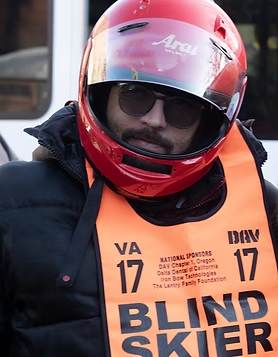
Army Veteran Clarence Davis enjoys snowmobiling on day 2 of the National Disabled Veteran Winter Sports Clinic on April 4, 2024, in Aspen, Colorado.

SNOWMASS, Colo. – Command Sergeant Major Clarence Davis was gearing up for his 14th deployment when his medical team dropped a bomb. After 20 years in the Army, he was going to be medically discharged. It felt like he was losing his sense of purpose.

Davis enlisted in 2001 just before September 11, and by October 1 he was headed to basic training. He was the first person of his family to enlist, driven by a desire for travel and adventure, and to avoid the humdrum of a 9 to 5.

His special forces career took him on 13 combat deployments to Afghanistan, Iraq, Africa – to name a few. Davis was a member of the 160th Special Operations Aviation Regiment (Airborne), also known as the Night Stalkers.  

“I was scheduled for my 14th deployment, but when my new care team saw my medical records, they said ‘You’re done. You have nothing else to prove,’” recalled Davis. “My deployment orders were canceled.”

Davis was sent to the Fort Bragg Soldier Recovery Unit (SRU), where he received surgery on his feet and was scheduled for shin, knee, and hip surgeries. He estimates that he spent eight to twelve months in full time medical treatment at the SRU. With 40 service-connected disabilities, many of his injuries are invisible, including chronic PTSD, multiple traumatic brain injuries, and migraines.

However, the shock of his medical retirement lasted past his time in the SRU.

“My sense of purpose was lost, I was lost,” said Davis. “I was a Command Sergeant Major and then I was out of the military, just like that. It was really tough for me when I transitioned out.”

Losing his sense of purpose was devastating for Davis. He withdrew from family and friends and stopped doing things he loved. It took him about six months before he reached out to the VA, after a friend told Davis he needed to seek help.

He currently receives his care at the VA Washington DC Health Care System, and his care team referred him to recreation therapy. He was skeptical at first, but the recreation therapist helped change his perspective. She told Davis not to focus on what he can’t do anymore, focus on what he can do.

Davis fell in love with recreation therapy, and he now tries any sport he can. He is involved in bicycling, kayaking, rock climbing, sailing, tennis, badminton, pickleball and more.

“Recreation therapy got me out of that depression. I felt like I had purpose again. I started being around Veterans outside of a therapy setting, so it was more about camaraderie and fun,” said Davis. “It just changed my whole way of thinking about fitness, but also happiness, joy and a sense of purpose.”

The recreation therapists introduced him to the VA Adaptive Sports and Arts events. In 2023, Davis attended the National Disabled Veterans Winter Sports Clinic for the first time.

He had never tried skiing before his first Winter Sports Clinic, and it is now his favorite adaptive sport.

“I love the independence of it, I love being up there by myself with a pair of instructors to keep me calm, and just being in the mountains.”

Davis also loves the Winter Sports Clinic for the sense of belonging he feels amongst fellow disabled Veterans, where everyone can relate to each other on some level. He enjoys being able to talk with other Veterans and share his story.

“Life is not over after the military. You may need to adapt, just like the military taught us, but you can adapt and overcome.”

Veterans Stories - Army Veteran and amputee focuses on Paralympic dream, future goals

April 4, 2024

Army Veteran and amputee focuses on Paralympic dream, future goals

Posted By: Web Admin
Donna J. Bell

“Anger is not a perfect circle of stages you work through — it is a big ball of craziness,” U.S. Army Veteran Amanda Seward said of her journey of healing and acceptance. She enlisted in the Army in 2011, however, after a decade of service and two deployments to Kuwait, it was a typical day on the job as a Guard Reserve recruiter in January 2019 that left her disabled. Only a month back from her second deployment, she pulled her car over to the side of the road and, after exiting, was struck by a vehicle from behind.

Several months later, after several surgeries to try and salvage her limb and a struggle with infections, she and her providers at Walter Reed Medical Center made the difficult decision to amputate her leg in April 2019. What followed was a seemingly endless number of therapy, procedures, and prosthetic appointments that led to her being medically retired in 2021.

“I had so much emotion, but I had to learn and grow, adapt and become better,” Seward said, stating that it was difficult to realize how people saw her had changed.  

“I have this injury, but it is not what defines me. People try to make it the first thing they relate to me,” she said, adding that people are thrown by the thought of a female amputee and wishes that there was better education about amputees and disabilities, starting with educating school children. She feels that most people don’t think about disabilities until it affects them, and so don’t have the education to realize that a disability doesn’t limit the ability to live a full life.

Now, in her second year at the National Disabled Veterans Winter Sports Clinic, Seward is not only living a full life, she is looking forward to accomplishing even more as she works toward new goals – qualifying for the 2026 Paralympics in snowboarding and creating a non-profit organization called Taking Art into Battle. The latter would allow members of the military and Veterans to proactively participate in art and creative therapy. Through this non-profit, Seward hopes to be able to appear before Congress to advocate for creative arts positions in the military. However, this week her focus on the slopes is dedicated honing her snowboarding skills and learning to ride  “goofy”.

And while the daily struggles of mental and physical pain can still overwhelm Seward at times, she says she can now see more of what the world has to offer. Coming to Winter Sports Clinic, she said, allows her to get a hug or have deeper conversations those who truly understand where she has been.

“We need to tell each other that it is OK to ask for help, you are not any less,” she said. “Find your team, because they will support you and make you strong.”

She paused and took a breath. “Find your team.”

Veterans Stories - Clinic shows disabled Army Veteran she can ‘do anything’

Clinic shows disabled Army Veteran she can ‘do anything’

Posted By: Web Admin
Brenda Reed

Brenda Reed out-processed from the Army on crutches.

Reed had injured her foot while running in ill-fitting combat boots designed for men, and the physician assistant on base didn’t take the injury seriously. Reed was told to suck it up and go back to work.

Eventually, at her sergeant’s insistence, Reed was sent to a hospital where she learned her foot had been broken in four places and was healing incorrectly. Before she knew it, her military career was over—and that was only the beginning of one of her biggest trials.

Reed’s injury worsened over the years. When she twisted her ankle on the same foot—a minor injury for most—the bones in her leg shattered. By 2013, after years of major surgeries, Reed’s leg was amputated.

Afterward, Reed, who survived sexual assault in the military and dealt with post-traumatic stress disorder, felt vulnerable and unsure of how she would protect herself if needed. Two years later, she found herself flying down a snow-covered mountain on a bi-ski in Snowmass, Colorado, feeling anything but vulnerable. She felt empowered.

“After that, it was like, you know, I can still do anything,” said Reed, who currently serves as the DAV Department of Florida commander.

This year marks Reed’s eighth time attending the National Disabled Veterans Winter Sports Clinic. Along with bi-skiing, she has participated in curling, fly-fishing and kayaking.

“I’ve done just about every sport, except I’m not really crazy enough to do the sled hockey,” she said.

Jokes and sled hockey aside, the clinic continues to give Reed more than she ever thought possible.

“It’s just been like an entire world of opportunities has opened up,” she said.

Along with the healing power of adaptive sports, Reed said she’s found a special community through the clinic.

“It’s kind of like a reaffirmation that we’re OK; we’re going to be fine. We’re going to make it through whatever is going on, because we have the support of all these people,” Reed said.

The clinic has also been a good way for Reed to meet other women Veterans.

“I’ve made friends with so many women there, and we have formed a support group and we call each other and keep in touch throughout the year,” she said.

Reed admits her first time at the clinic in 2015 was a bit scary, and she understands Veterans who may be hesitant or pessimistic. But she urges them to push past that and take the chance.

“It’s a little scary your first run, but then when you realize that someone has your back, you just kind of let go and start enjoying it,” she said.

“That’s when the exhilaration comes. That’s where the miracle comes from.”

Veterans Stories - Army Veteran nearly killed in Iraq personifies determination

Army Veteran nearly killed in Iraq personifies determination

Posted By: Web Admin
Erik Castillo

When Army Veteran Erik Castillo came out of a nearly two-month coma, he was at Walter Reed Army Medical Center in Washington, D.C.—more than 6,000 miles from where he had been wounded in Baghdad.

He was seven months into his deployment in 2004 and standing next to his Humvee when a nearby explosion hurled shrapnel through the right side of his head and into his brain 

“I woke up paralyzed,” Castillo said. “At first, I didn’t know what happened to me. It was confusing. Over time, I actually was able to process and understand how bad the injury was.”

Doctors had removed a portion of his skull and brain to save his life and gave him very low odds that he’d ever walk or talk again.

But Castillo said his body was telling him different.

“It makes you want to get back to your normal state, which to me before going to sleep—obviously with the coma—was walking,” he said. “It’s all natural that your body wants to do things how it naturally does it.”

As much as he felt his body fighting to heal and walk again, it was an arduous process to regain any sense of independence.

For years, he used a wheelchair, only able to walk “like a stiff robot” for short distances during physical therapy. He endured countless hours of rehabilitation. He’s had 22 surgeries to reconstruct his face and head, and address other medical issues. He battles memory loss and physical limitations because of his traumatic brain injury.

“I always tell people, if you don’t have it in you, it’s easy to be able to just curl up in a ball and give up and not try,” Castillo said.

He didn’t give up, though, and credits the Department of Veterans Affairs and his family for creating a strong support system that helped him persevere and overcome the odds.

Today, Castillo is a graduate of the University of Arizona and works as an advanced medical support specialist at the VA medical center in Tucson, Arizona. He no longer uses a wheelchair.

However, it wasn’t until last year that he learned about the VA’s adaptive sports program and the opportunities it presented.

“It was kind of life-changing because it gives you a brand-new outlook on life of what you can do,” said Castillo, who had only previously attended the VA’s National Veterans Wheelchair Games once in 2009.

He said attending the 2023 National Disabled Veterans Winter Sports Clinic, co-presented by the VA and DAV, reminded him that he wasn’t alone in his recovery and allowed him to learn how others cope and thrive with their injuries. It was also the first time since he was a young teenager that he got to go skiing.

“I was a little bit scared, but I trusted the instructor to help me learn how to ski and obviously keep me safe on the mountain,” he said.

That experience led him to exploring the other adaptive sports options the VA offers and to encouraging other eligible Veterans to join him.

Castillo’s advice for first-time participants is to not be timid.

“Be open and trust the people that are there to help you be successful and safe to do the events,” he said.

For him, though, the clinic is much more than the sports and activities. It’s also the perspective that comes from developing relationships with the community of Veterans participating. 

“Your whole outlook on life changes,” said Castillo. “I think these clinics are actually very powerful.”

Veterans Stories - U.S. Army Veteran, VA recreation therapist Foster Enduring Bond on Miracle Mountain

April 3, 2024

U.S. Army Veteran, VA recreation therapist Foster Enduring Bond on Miracle Mountain

Posted By: Web Admin
Brent King

SNOWMASS, Colo. – It’s been nearly three decades since U.S. Army Veteran Brent King and his Spokane VA Healthcare System Recreational Therapist Vance Pease first met. This year, both men returned to Snowmass to participate in the 38th annual National Disabled Veteran Winter Sports Clinic, both professionally and personally as friends.

“My introduction to the Winter Sports Clinic came by way of the then chief of prosthetics for the Spokane VA Medical Center, who was a triple-amputee Marine Corps Veteran,” King shared. “Even though I was hesitant about attending, he told me I was going; that push was the best thing that could have happened to me.

”King, who served from 1988 to 1995, experienced his first major injury after surviving an 18-foot fall during a training exercise. Then, 18-years after the initial injury, bone infections led to the painful decision to amputate both of his legs.

“At first, I was consumed by self-pity and I had a pretty bad attitude,” King, who is a member of the DAV chapter in North Idaho, said. “Then I went to my first Winter Sports Clinic and everyone – from the staff to the Veterans – was happy. Being in that environment really motivated me and from there, I just changed my attitude.”

A successful mortgage broker and general contractor, King credits the adaptive sports event with changing his life for the better. He currently serves as the executive director for the northwest chapter of the American Paralyzed Veterans of America.

“I’m really grateful for everyone who makes this event possible,” said King. “The Winter Sports Clinic could not function smoothly without the support it receives from the volunteers, donors, and VA staff.”

That last category is a group King is particularly grateful for and, according to Pease, the feeling is mutual.

“Working with Brent has been incredible. The example he sets for other Veterans is profound and seeing the impact he has reinforces what I know to be true about the VA,” Pease shared. “Events like the Winter Sports Clinic prove that there are people who can face adversity and get back to seeking true enjoyment, what is meaningful, and what gives them purpose.”

Veterans Stories - Disabled Air Force veteran to others: ‘Life doesn’t suck’

April 1, 2023

Disabled Air Force veteran to others: ‘Life doesn’t suck’

Posted By: Web Admin
Matthew Kosto

Matthew Kosto has an honest, if not blunt, catchphrase: Life doesn’t suck. It’s a mantra that took on a new meaning for him after he lost his right leg in a motor vehicle accident in 2021.

“When I was going through my initial recovery process, I had a bunch of bracelets made up with that motto,” he said. “And when I run into people having hard times, I give them one and offer some perspective on my life, which really helps them out.”

Kosto retired from the Air Force in 2016 after 20 years of maintaining F-15 Eagle and A-10 Thunderbolt II jet aircraft. His service spanned the globe, with visits repeatedly bouncing him between Alaska and Korea, throughout the Middle East and Afghanistan, and all over the Pacific, he said.

When it was time to hang up his uniform for good, the service-disabled veteran settled on a familiar duty working on the A-10 as a civil service engineering representative at Davis-Monthan Air Force Base in Tucson, Arizona.

That’s where his life changed forever.

Kosto was riding into work on his Harley-Davidson when a pickup truck struck the motorcycle from behind. He careened down the road, which caused him to lose his lower leg that day and begin his journey toward a new normal as a below-the-knee amputee.

As a self-described “pretty stubborn military veteran,” Kosto didn’t want his newfound physical limitations to keep him from his beloved mountains and desert of southern Arizona.

“When I first met with the VA prosthetics team, I said I wanted to be able to do more without a leg than I did with two,” said Kosto. “I’m trying to be as active and as positive as possible about my disability.”

When physical therapists at the Department of Veterans Affairs encouraged Kosto to apply to the National Disabled Veteran Winter Sports Clinic, he didn’t hesitate.

Matthew Kosto

This is Kosto’s first time attending the clinic, and he is most looking forward to trying something new.

“I lived in Alaska for 11 years, but I didn’t really get into skiing,” he added. “So I want to give it a try.”

Although he typically reserves his coveted “Life Doesn’t Suck” bracelets for wounded active-duty airmen during resiliency stand-downs on base, Kosto said he’d have a few available at the clinic if another disabled veteran needs an uplift.

Veterans Stories - Veteran, Cyborg or both?

March 31, 2023

Veteran, Cyborg or both?

Posted By: Web Admin

SNOWMASS, Colo – John Wade, or Big John, as he is known to the Winter Sports Clinic community, also goes by his own self-proclaimed nickname – John the Cyborg. Wade, an Army Veteran who receives his care at the Cleveland VA Medical Center, served from 1991 to 1998 and again from 2004 – 2012.

John Wade

It was August 2018, in an act of selflessness, that he became an amputee. The brakes failed on a semi he was driving and rather than crushing the cars in his path, he swerved off the road. Seven weeks later, he regained consciousness and discovered he was missing his left leg below the knee. Four suicide attempts later he made a conscious decision to practice self-love and decided he needed to either “be busy dying or be busy living.”

He was at the Cleveland VAMC when he was approached by a researcher who was developing an experimental treatment for amputees. Fast forward to November 2022, and Wade was implanted with 64 electrodes in his left thigh with the hope that it would pick up his brain’s electrical signals for movement. The experimental research is being conducted by researchers from the Massachusetts Institute of Technology (MIT) and Case Western University, in conjunction with the Cleveland VAMC. Eventually, Ward said, he will receive a robotic limb that his brain can control.

Recently, he had the opportunity to test a prototype that plugged into his electrodes, and for the first time in years, he experienced the feeling of his foot hitting the ground.

John Wade

“It brought tears to the eyes of everyone in the room,” he said with a catch in his voice. ”My brain remembered the feeling and I was able to walk normally again.” Ward said another benefit was relief from his phantom limb pain he described as “like sciatic nerve pain.”

And while his robotic leg is still in the development phase, Wade is participating again at the National Disabled Veterans Winter Sports Clinic in Snowmass, Co. This year he had the opportunity to try out another type of prosthetic – a G-3 Infinity Knee that is specifically designed to allow amputees to participate in outdoor activities. The knee features an advanced pneumatic/hydraulic shock that provides an enormous range of options for making micro-adjustments on the fly – extraordinarily useful for sports like downhill skiing. The knee is the brainchild of Brian Bartlett, who created the device after he lost his own leg.

“I’m just so grateful to have these opportunities,” Wade said of the chance to try the G-3 and the ability to participate at this year’s event, adding “Winter Sports Clinic is the Emmy Awards of sports events.”

Veterans Stories - Combat-wounded veteran finds peace in fly-fishing

Combat-wounded veteran finds peace in fly-fishing

Posted By: Web Admin

The first time combat-wounded Army veteran John Thomas went fly-fishing, he found peace.

“It was [like] no other feeling,” he said. “I did more looking up and not looking down on the fly and the current water taking it to where I could just see the sceneries around me, and it just took me away.”

John Thomas

It was also therapeutic for his ravaged body. Thomas was in the middle of what he calls “nasty chemotherapy” for non-Hodgkin lymphoma. Standing in the water with waves gently crashing into his back was a relief to his tired joints.

This week, Thomas will enjoy the landscapes and natural remedies of Snowmass, Colorado, as he attends his first National Disabled Veterans Winter Sports Clinic, co-presented by DAV and the Department of Veterans Affairs. While the event is best known for its adaptive skiing, veterans can also participate in sled hockey, curling, snowboarding, snowmobiling and fly-fishing.

“Being outdoors is a mental reset for me,” Thomas said.

His cancer diagnosis in 2015 was one in a series of blows to the double Purple Heart recipient. Thomas was first injured in 2003 when his vehicle was ambushed while guarding traffic control points in Iraq. He sustained shrapnel wounds to his leg but remained in the country and returned to duty soon after.

John Thomas

Then in 2008, he was injured in a suicide bombing while he was on guard in Afghanistan. He sustained traumatic brain and spinal cord injuries, along with more shrapnel across his body. Still, he continued serving. Ultimately, the cancer diagnosis led to his separation from the military in 2016.

“I would still be wearing the uniform to this day [if I could],” Thomas said.

After leaving the Army, Thomas struggled with the effects of his traumatic brain injury and the weight of survivor’s guilt. In turn, he isolated himself.

Until that day on the water. Thomas credits the outdoors and the organization Project Healing Waters Fly Fishing—a previous recipient of a DAV Charitable Service Trust grant—with saving his life.

Now he regularly participates in and guides outdoor excursions with other veterans. He strives to live in honor of his fallen brothers and sisters and help other veterans do the same.

For his sacrifice and selflessness, DAV members in Thomas’ South Carolina hometown collaborated with the TV program “Military Makeover With Montel” to provide Thomas and his family with a more accommodating home. Past Freedom Award recipient and DAV Ambassador CeCe Mazyck made an appearance and invited Thomas to the clinic.

“I’m speechless still, and I’m very grateful to be invited and excited to come join everybody,” Thomas said, adding that he’s most excited about the camaraderie among veterans and building new relationships.

“I just want to share and connect with others to where they can feel comfortable to reach out and I could feel comfortable to reach out, to where we could kick this veteran suicide rate down.”

Veterans Stories - Happy trails

March 30, 2023

Happy trails

Posted By: Web Admin

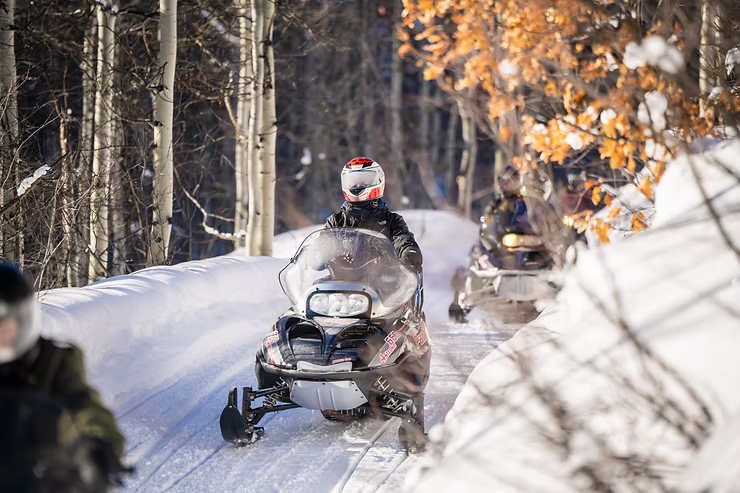
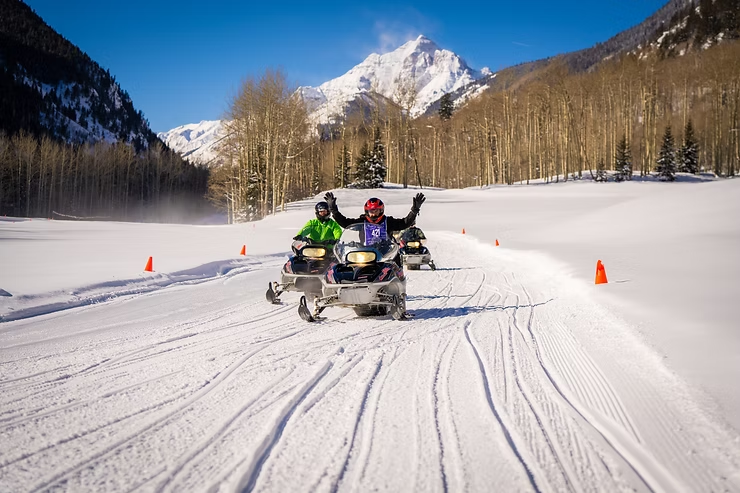
On a cold clear morning, sunlight glints off snowbanks as a line of snowmobiles zip through groves of aspens and towering firs. Pyramid Peak, sister of the famous Maroon Bells, towers ahead and a stunning panoramic view of Aspen lays behind.

Tucked in the scenic Maroon Creek Valley, the T-Lazy-7 Ranch has provided snowmobiling as an alternate activity for the National Disabled Veterans Winter Sports Clinic for more than three decades.

Winter Sports Clinic

“It’s one of our favorite things to do. We love to give back to the Vets and everybody has such a good time,” said owner Rick Deane, “A lot of people come back year after year and you get to know them. Many tell me this is the most fun they have ever had.”

Adapting snowmobiles for disabilities is a constant work in progress for T-Lazy-7. About five years ago, the team developed a seat back that helps paraplegic Veterans ride comfortably. Leg straps assist Veterans with mobility limitations stay safely on the sled, and a buddy will ride with Veterans with spinal cord injuries or limited visibility to help steer.

The crew at the ranch love the Veterans’ sense of humor and laugh about pranks that Veterans have pulled throughout the years. Billy McEnteer has been volunteering to assist Veterans at the WSC event for about 30 years and travels to the T-Lazy-7 every year from Grand Junction, Co. to help during this week. McEnteer recalls riding with a Vietnam Veteran with a spinal cord injury to help him steer. Several minutes into the drive the Veteran shared with McEnteer that he was also blind.

“We had stopped to get resituated, and then I told him to hit the throttle,” said McEnteer. “He said ‘are you sure, you know I’m blind, right?’ He came back for about 10 years after that.”

Deane, and his two children, Jesse Deane and Besha Jervis, run the ranch with the help of 25 seasonal employees. During Winter Sports Clinic, additional volunteers come to the ranch to help serve the Veterans.

Winter Sports Clinic typically falls just a week or two before snowmobiling shuts down for the season. This year, Deane estimates that there is about 5 feet of snow on the ranch, but many years the snow is nearly melted by the end of March.

Winter Sports Clinic

“When there are low snow years, they use the heavy equipment to stockpile snow around the ranch all winter,” said Jervis. “Then they create a ribbon of snow across the meadow. The volunteers and Rick are up all night through the week adding more snow to the trail – they’ll go to amazing lengths to make sure we can serve the Veterans.”