Veterans Stories - ‘A need for speed’

March 29, 2022

‘A need for speed’

Posted By: Web Admin
Terry Hayes

The ramp leading up to Terry “Scooter” Hayes’ front door isn’t just a necessity. It’s a chance to fly.

“I’m kind of a daredevil,” the Army Veteran and Paralympian said. “So I like to bolt down my ramp.”

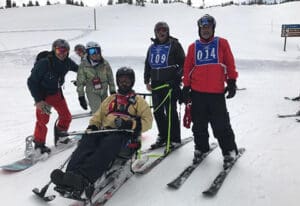
Hayes is taking her thirst for adrenaline to the mountains of Snowmass, Colorado, for the 36th National Disabled Veterans Winter Sports Clinic, co-presented by DAV (Disabled American Veterans) and the Department of Veterans Affairs. The annual event—known as “Miracles on a Mountainside”—allows profoundly disabled Veterans to participate in adaptive sports such as skiing, rock climbing and sled hockey.

Naturally, Terry is most looking forward to downhill skiing.

“I have a need for speed,” the lifetime DAV member said.

The snowy landscape will be new to the longtime Florida resident, but Hayes is no stranger to sports. As a kid, she and her sister would play “Olympics” in the backyard, creating a hurdle out of large trash cans and a broom for the high jump. Officially, she played competitive softball.
Terry Scooter Hayes

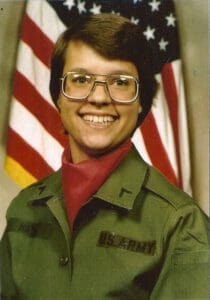
The daughters of a retired Army master sergeant, Hayes and her sister enlisted in the Women’s Army Corps in 1977. Two years later during a training exercise, Hayes lost her balance and fell, injuring her knee and requiring two surgeries. It was the beginning of a long road that would ultimately lead to a devastating diagnosis.

Hayes was honorably discharged the same year she injured her knee. In the years after, she kept losing her balance and falling. By 2011, she found herself needing to hang onto things just to walk–the kitchen counter, the wall, her wife Freda’s arm.

“I was scared at that point,” Hayes said. “And I said, something is radically wrong, I have to go and find out what the heck is going on here.”

Hayes was later diagnosed with primary cerebellar degeneration, a brain disease that gradually causes permanent paralysis.

“I was determined then that I was going to live my best life possible, no matter what,” Hayes said. “So far that has served me really well, and I’m loving life right now.”

Hayes admits to letting herself sulk for a couple of days after, and again in 2017 when she became paralyzed from the chest down. But Hayes quickly rallied, determined to extract every bit of joy and adventure from life that she can–whether it’s listening to disco music while cleaning or competing in adaptive fencing tournaments.

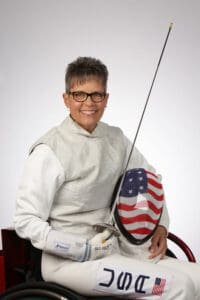
Hayes started wheelchair fencing when she was 58 years old. By 63, she was competing in the 2020 Tokyo Paralympic Games for Team USA.
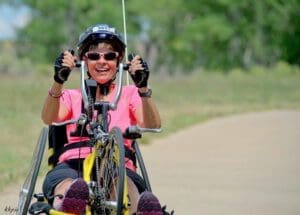
Terry Scooter Hayes

“You are never too old to get started into sports,” she said.

Neither age nor physical limitations will stop Hayes from flying down the mountains in Snowmass. Along with the adrenaline rush, she’s looking forward to meeting other disabled Veterans at the first big DAV event she’s been able to attend.

“I enjoy being around people like myself, other people that are in wheelchairs,” Hayes said. “So I’m looking forward to making some new friendships and just having a great time.

“I’m looking forward to the whole thing.”

Veterans Stories - Veterans Serving Veterans

March 28, 2022

Veterans Serving Veterans

Posted By: Web Admin

DAV is committed to fulfilling our promises to the men and women who served. For more than 100 years, DAV has been dedicated to helping our nation’s heroes rebuild confidence and regain balance in their lives. We will never waver in our commitment to empowering Veterans to lead high-quality lives with respect and dignity. Service is the cornerstone of everything we do.

As an organization of Veterans serving Veterans, DAV is there every day to help you and your families overcome the obstacles you face on your road to recovery. Our corps of highly trained service officers around the country provides professional assistance to Veterans and their families in obtaining earned benefits.

During 2021, DAV NSOs interviewed over 290,000 Veterans and their families and filed over 151,000 new claims for nearly 423,000 specific injuries or illnesses. Thanks to the great work of our service officers, claimants represented by DAV obtained more than $25 billion in benefits.

Our help is free, and you don’t need to be a member to qualify for assistance.

DAV is also a leader in connecting Veterans with meaningful employment, hosting job fairs and providing resources to ensure they have the opportunity to participate in the American dream their sacrifices have made possible. Information on employment services can be found at jobs.dav.org.

Additionally, DAV works to extend the mission of hope into the communities where Veterans and their families live through an expansive network of state-level departments and local chapters. DAV operates a nationwide volunteer network and has created a new resource to connect Veterans with volunteers at VolunteerforVeterans.org.

DAV also advocates in Washington for Veterans’ care and benefits. The transition from service member to civilian isn’t easy, but DAV is here to help you on the journey.

Veterans Stories - Marine Veteran is ‘free’ on slopes

Marine Veteran is ‘free’ on slopes

Posted By: Web Admin

In spite of a wound that could have killed him, Iraq War Veteran Colin P. Smith is hitting the slopes.

ree

The medically retired Marine lance corporal is skiing at the National Disabled Veterans Winter Sports Clinic in Snowmass, Colorado.

Smith, 34, said he was struck in the head by a sniper’s bullet in 2006 in Iraq.

“I was in a Humvee, and a gun turret, and yeah,” Smith said.

The northern Ohio resident was partially paralyzed on the right side of his body by the round that pierced his helmet. Smith said he can walk, but that he cannot use his right arm. His speech is affected by aphasia, a partial loss of ability to express himself using spoken words.

Smith will be returning to the clinic, which is co-presented by DAV (Disabled American Veterans) and the Department of Veterans Affairs, for a second time.

The VA’s skilled adaptive sports professionals find ways to allow everyone to participate, he said. One of the nurses from his rehabilitation in Minnesota was part of the medical crew the last time he was at the clinic. That made for a special reunion, he said.

ree

Newcomers to the clinic should hydrate, and be open to new possibilities, Smith said.

At home, just west of Cleveland, Smith works with local adaptive groups to ski on what are some smaller hills compared to Colorado. On the slopes, Smith said he only feels one thing.

“I just feel free,” he said.

His mother, Melissa Smith, said her son was always a daredevil. Adaptive skiing takes skill, and you can fall, so successfully going downhill gives a sense of accomplishment, she said.

“It’s just the smiles on his face is why we’re going back,” she said.

“DAV and the VA empower Veterans to challenge themselves at the clinic to show the world and themselves that they are resilient and powerful,” said DAV National Voluntary Services Director John Kleindienst.

“Our Veterans fought for their freedom, and an injury or illness does not stop our determined heroes from being self-reliant and striving to live their lives in the most independent way possible,” Kleindienst said. “This clinic is a place where Veterans are inspired to break through perceived limitations.”

Veterans Stories - 400 disabled Veterans to take on Snowmass Mountain for adaptive sports challenge

March 3, 2020

400 disabled Veterans to take on Snowmass Mountain for adaptive sports challenge

Posted By: Web Admin
Winter Sports Clinic

WHAT: The National Disabled Veterans Winter Sports Clinic, presented by the U.S. Department of Veterans Affairs (VA) and Disabled American Veterans (DAV), serves as a world leader in adaptive winter sports instruction for disabled Veterans and promotes world-class health care and rehabilitation. Veterans experience opportunities for self-development and challenge through sports therapy and leisure activities such as adaptive Alpine and Nordic skiing, rock climbing, sled hockey, scuba diving and other adaptive activities.

WHEN & WHERE: March 29 – April 3 in Snowmass Village, Colorado.

WHO: Since 1987, the National Disabled Veterans Winter Sports Clinic has served thousands of disabled Veterans living with traumatic brain injuries, spinal cord injuries, orthopedic amputations, visual impairments, certain neurological conditions and other disabilities. Participation is open to U.S. military service Veterans from all eras ranging from WWII to Iraq and Afghanistan.

WHY: The National Disabled Veterans Winter Sports Clinic has helped many disabled Veterans overcome obstacles and challenge their perceived limitations. The clinic helps them to recognize the physical and mental healing that skiing and other winter sports can provide to increase their confidence and independence. Each year, hundreds of Veterans attend from across the country, along with 200 certified disabled ski instructors and members of the U.S. Disabled Ski Team.

ADDITIONAL DETAILS: Interviews, b-roll, photos and other media opportunities are available leading up to and including the week of the event.

For more information contact Jennifer Dikes at, 385-227-2906, [email protected] or Todd Hunter at 202-314-5219, [email protected].

Veterans Stories - A life-changing event, disabled Veterans to take on Snowmass in adaptive sports challenge

A life-changing event, disabled Veterans to take on Snowmass in adaptive sports challenge

Posted By: Web Admin
Winter Sports Clinic

WASHINGTON — Today, the Department of Veterans Affairs (VA) announced that the National Disabled Veterans Winter Sports Clinic will take place March 29 – April 3, 2020 in Snowmass, Colorado.

The annual clinic, presented by the Department of Veterans Affairs (VA) and DAV (Disabled American Veterans), serves as a world leader in adaptive winter sports instruction for disabled Veterans, and promotes the world-class healthcare and rehabilitation that is a primary goal of the VA and DAV. Veterans experience opportunities for self-development and challenge through sports therapy and leisure activities such as adaptive Alpine and Nordic skiing, rock climbing, sled hockey, scuba diving and other adaptive activities.

“Adaptive sports therapy gives freedom to those heroes who have fought for our freedom,” VA Secretary Robert Wilkie said. “This clinic empowers Veterans to move past perceived limitations, reach their own personal victories and prove the impossible is possible.”

For many of the hundreds of Veterans who participate in the clinic, the adaptive sports journey is just beginning. For others, it becomes a way of life in Snowmass and is a passion they take back home. The hope is that Veterans will build upon this experience and continue to lead active, healthy lives and overcome perceived limitations.

“Being seriously wounded, injured or ill in military service is a life-changing event that can be mentally, physically and emotionally debilitating,” said DAV National Commander Stephen “Butch” Whitehead, the first post-9/11 Veteran to serve at the helm of the organization. “Fortunately, events like this clinic give us the opportunity to push past our perceived limitations and prove to ourselves and others how much we really can do. It’s incredibly empowering.”

Hundreds of volunteers, strategic corporate partnerships, nonprofit organizations and individual donors make this life-changing clinic possible.

Interviews, b-roll, photos and other media opportunities are available leading up to and including the week of the event; please help us get the word out. For more information, contact: VA’s Jennifer Dikes at 385-227-2906, [email protected] and DAV’s Todd Hunter at 202-314-5219, [email protected].

Veterans Stories - Returning to the Mountain of Miracles

Returning to the Mountain of Miracles

Posted By: Web Admin
David Riley

This past week and over the past several years, you may have seen me here at the National Disabled Veterans Winter Sports Clinic—flying down the mountain. You’ve probably seen me fall down on the mountain, too!

Before my disabilities, I was an adrenaline junkie. It’s what led me into the Army and then to become a rescue swimmer in the Coast Guard.

But I thought that was all over in 1997 when I woke up from a coma and discovered that in order to save my life from a devastating bacterial infection, doctors had removed all four of my limbs.

I was medically retired from the military just over two decades ago. If you had told me that one day I would be flying down a mountain with snow flying everywhere and the wind whipping past me, I would have never believed it. I would have never believed that I would one day be skiing, rock climbing and playing hockey.

Each of you understands how a single moment can change everything in our lives. Whether it’s the diagnosis of a life-changing medical condition or a devastating injury, we are all susceptible to one day being faced with challenges that change our daily lives and our future visions. These injuries and medical conditions create obstacles, but they don’t have to stop us from living full, active lives. We need to be determined to overcome those obstacles that try to block us physically and mentally.

I’ve learned to conquer this mountain with no arms and no legs. Was it easy? No. I was determined to do it, but that didn’t mean it was going to be easy. I fell down. A lot! But I got back up. And later I would fall, but I would get back up again. I was determined to prove to myself I could do it, but it was really inspiration from my fellow veterans—fighters and warriors—who always got back up.

That is what we do at the clinic. We may slip and we may fall—but we never, ever give up. It’s about teamwork, too. We are not here alone. We have hundreds of battle buddies beside us who will not allow us to fail, and we won’t let them fail.

I encourage you to take what you have learned about yourself out on the mountain this past week back to your communities. You have achieved great things this week—don’t stop when you leave Snowmass.

I know you can do it!